
In 1995, a famous arachnologist by the name of Norman Platnick wrote “Wherever you sit as you read these lines, a spider is probably no more than a few yards away” [6]. Over time, his thankfully hyperbolic statement became a common myth. Though, unlike Platnick’s mythical spiders, radio signals originating from wireless access points (APs) are constantly surrounding you. In fact, wireless APs are so ubiquitous that nearly every home, business, hospital, and airport (and even each airplane) has at least one. The proliferation of these access points allow us to connect wirelessly to the internet from almost any location.
Even if you don’t use these access points, your phone will continuously send out probe requests (sometimes referred to as “beaconing”) in an attempt to connect to one [3]. Based on these probe requests, it’s possible to locate your phone with a deviation of 5-15 meters from the device [3][8]. However, recent advances in this technology will soon increase accuracy to within a meter [1]. In other words, this technology can let your boss know just how much time you spent hanging out in the break room when you swore that you were “too busy” today to attend the mandatory 9 a.m. all-hands meeting.
That being said, the intention of Wi-Fi localization isn’t to invade worker privacy. It’s easily circumvented by disabling Wi-Fi on your phone while you’re at work, and most companies frown on using it to track workers. Instead, Wi-Fi localization is primarily used to measure occupancy and crowd flows [3]. For example, it’s possible to tell how well a talk at a conference was received by determining if the vast majority of the attendees went to the speaker’s booth or to their competitors’.
Received Signal Strength Indicator (RSSI)
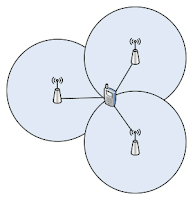
Engineers and researchers have developed various methods of Wi-Fi localization over the past 10 years. However, a method known as RSSI (received signal strength indicator) has become the most prolific approach due to its cost efficiency [10]. The closer the user’s device is to a given AP the higher the received signal strength (RSS). By measuring the difference in RSS between the device and at least 3 APs, the location of said device can then determined by a process known as N-point lateration [10].
Issues with RSSI arise when the device isn’t in direct line of sight of the wireless APs. Any large obstacle, such as an office wall, causes severe signal attenuation (signal loss) [10]. Also, RSSI suffers from multipath fading which occurs when a radio signal reflects off objects before returning to the receiver [7][10]. This results in the same signal being received from multiple directions or “paths.” Multipath fading becomes especially problematic in office spaces and warehouses which have numerous walls, pallets, and chairs off of which signals can reflect.
Fingerprinting
The next commonly used method of indoor wireless localization is known as fingerprinting [10]. It also relies upon RSS; however, fingerprinting is split into four phases. The first phase of fingerprinting involves breaking up the physical space into a coordinate grid [4]. Next, a device (such as a laptop) is taken around to each coordinate to measure the RSS between the device and nearby wireless APs [4]. The RSS information and name (SSID) of the closest wireless AP is then stored alongside each coordinate in a database [5]. In the third step, the system is brought online and the measurements are compared against those taken offline to determine user location [4][10]. Finally, the results are analyzed for performance and grid coordinates are adjusted accordingly.
Angle-of-Arrival (AoA)
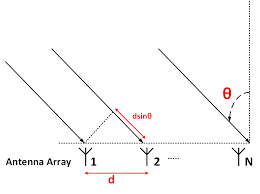
Unlike RSS based techniques which rely on multiple receivers, the angle of arrival (AoA) method only requires two wireless APs [10]. Each of these access points must have a linear array of antennae. The angle of arrival is calculated by leveraging the time differential between the same signal arriving at different antennae [10]. The greatest issue with this approach comes from the drastic decrease in accuracy which occurs as the user’s device moves increasingly farther away from the wireless AP pair [10]. Additionally, AoA suffers from the same multipath fading issues which plague RSS based systems [10].
Time-of-Flight (ToF)
Instead of measuring signal propagation times between antennae, time of flight (ToF) uses the signal propagation time between the device and the wireless AP to directly calculate the distance. Once the propagation time has been calculated, the time in seconds is simply multiplied by the speed of light (3 x 10^8 m/sec) [10]. Though this approach seems straightforward and easy to implement, it suffers from massive downsides. First, the user’s device must be synchronized with the AP at all times and constantly sampled. This is because low sample rates can result in missed signals and therefore lower accuracy [10]. As with other solutions, this method is affected by line of sight issues. In this case, obstacles scattering the signal lead to said signal traveling through a longer path. By being forced to take a longer path, the signal propagation times are significantly increased thereby resulting in the incorrect reporting of the device’s distance from the wireless AP [10].
Round Trip Time (RTT)
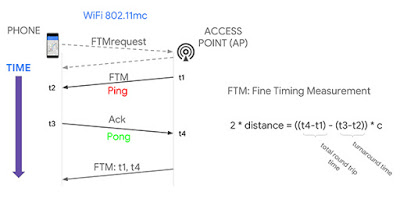
As previously stated, each of these methods only result in localization ranges between 5 and 15 meters of the device. For more advanced use cases, (trying to find where your phone that you just put on silent is now hiding at) the accuracy needs to be much greater. Therefore, a new Wi-Fi standard known as 802.11mc was produced which includes a feature known as Wi-Fi round trip time (RTT) [2]. RTT works much the same as ToF in that it calculates the time the signal takes to get from transmitter to receiver [1][10]. Though, as the name implies, another measurement is taken on the way back to the transmitter and the final calculation is done on the transmitter instead of on the receiver. Sadly, RTT encounters the same issues as ToF but in a more substantial way as the signal must be transmitted and received twice [10].
Wi-Fi localization is a relatively new area of study which has seen an influx in R&D efforts in recent years. This influx has resulted in the production of many novel methods for tracking devices indoors. Though the majority of these methods see an accuracy of 5 meters, the newly designed RTT approach has the potential to unlock one-meter localization [3][8]. Once this granularity has been achieved, the focus will inevitably shift away from improving base accuracy and towards finding novel ways to deal with signal attenuation. Solving this issue will pave the way for use cases beyond corporate interests. By working together, engineers, architects, and safety officials can ensure that this technology is used to improve event security, facilitate evacuation route planning, and aid in the location of disaster victims.
References
- Diggelen, F. V. , Want, R. & Wang, W. (2018). How to achieve 1-meter accuracy in Android. Retrieved from: https://www.gpsworld.com/how-to-achieve-1-meter-accuracy-in-android/
- Everything You Need to Know About 802.11mc. (n. d.). Retrieved from: https://www.netspotapp.com/everything-about-802-11mc.html
- Indoor Positioning, Tracking and Indoor Navigation with Wi-Fi. (n.d.). Retrieved from: https://www.infsoft.com/technology/sensors/wifi
- Ja’afar, A., Hashim, N. M. Z., Isa, A. A. M., Ali, N. A., Darsono, A. M., (2013). Analysis of Indoor Location and Positioning via Wi-Fi Signals at FKEKK, UTEM. International Journal of Engineering and Technology, 5, 3570-3579. http://citeseerx.ist.psu.edu/viewdoc/download?doi=10.1.1.411.4447&rep=rep1&type=pdf
- McGlynn, P. (2014). The Guide To Indoor Location Services. Retrieved from: https://bluefletch.com/the-guide-to-indoor-location-services/
- Myth: You’re always within three feet of a spider. (n.d.). Retrieved from: https://www.burkemuseum.org/collections-and-research/biology/arachnology-and-entomology/spider-myths/myth-youre-always-within-three-feet-spider
- Multipath Fading. (n. d.). Retrieved from: https://www.electronics-notes.com/articles/antennas-propagation/propagation-overview/multipath-fading.php
- Steampunk Spider. Retrieved from: https://www.pinterest.com/pin/251990541623592399/visual-search/?cropSource=6&h=470&w=470&x=10&y=15
- Wi-Fi positioning – efficient and low cost indoor location. (n.d.). Retrieved from: https://combain.com/about/about-positioning/wi-fi-positioning/
- Zafari, F., Gkelias, A., & Leung, K. K. (2019). A Survey of Indoor Localization Systems and Technologies [PDF file]. Retrieved from: https://arxiv.org/pdf/1709.01015.pdf

 Coffee × Tech